
 Written by
 MARSHFIELD, MA — While many associate the birth of radio with Guglielmo Marconi’s “dots and dashes,” the true revolution of the human voice began right here on the shores of Brant Rock.
In the early 1900s, Canadian-born inventor Reginald Aubrey Fessenden looked at the rugged coastline of Marshfield and saw the perfect staging ground for a global experiment. Working from his station at Blackman’s Point, Fessenden achieved two milestones in 1906 that laid the foundation for every radio station, podcast, and cellular call we use today.
January 1906: The First Two-Way Conversation
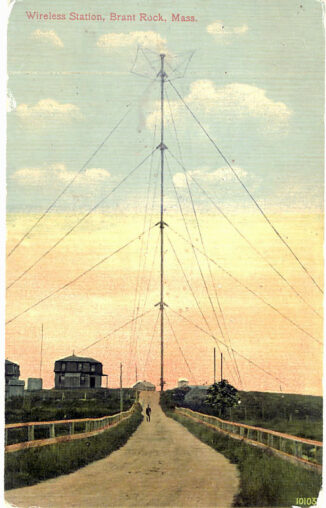
Before Fessenden, wireless communication was a one-way street. In January 1906, Fessenden successfully exchanged Morse code messages between his 420-foot steel tower in Brant Rock and a twin station in Machrihanish, Scotland. This was the first time in history that two-way transatlantic communication had been achieved, proving that the ocean was no longer a barrier to instant dialogue.
Christmas Eve 1906: The “Miracle” on the Airwaves
The most famous moment occurred on December 24, 1906. Using a high-frequency alternator he developed with GE, Fessenden did what many thought impossible: he transmitted sound.
Startled radio operators on United Fruit Company ships and Navy vessels—who were used to hearing only the rhythmic clicking of telegraphs—suddenly heard a human voice through their headsets. Fessenden’s program included:
- A brief introduction by Fessenden himself.
- A phonograph recording of Handel’s “Largo.”
- A live violin solo of “O Holy Night” performed by Fessenden (who also sang the final verse).
- A reading of the biblical passage: “Glory to God in the highest and on earth peace to men of good will.”
“The broadcast was heard as far away as Norfolk, Virginia, and later transmissions on New Year’s Eve reached the West Indies.”
The Legacy Today
The massive Brant Rock tower was eventually dismantled in 1917, but its impact remains. If you visit the site today at the end of Blackman’s Point, you can still see the original concrete-and-ceramic base that supported the 420-foot mast.

A historic plaque at the site commemorates Fessenden as the “Father of Radio Broadcasting,” ensuring that while the tower is gone, the signal he sent out from Marshfield continues to resonate through history.
Quick Facts:
- Location: Blackman’s Point, Brant Rock (Marshfield, MA).
- The Tower: A 420-foot tubular steel guyed mast.
- Key Innovation: Amplitude Modulation (AM), allowing voice/music transmission.
- First Song: “O Holy Night” (Violin).